


I. Product Characteristics of Large Wooden Crate Aluminized Woven Bags: Dual Advantages of Structure and Performance
Large wooden crate aluminized woven bags are not simply a combination of "wooden crate + aluminized woven bag," but rather an integrated packaging solution that combines aluminized woven bags with a wooden frame through a special process, providing both structural support and functional protection. Its core characteristics are reflected in three aspects: structural design, material performance, and specification compatibility, meeting the diverse packaging needs of large goods.
(I) Structural Design: Balancing Support and Flexibility
The structure of large wooden crate aluminized woven bags typically consists of two parts: a "wooden frame" and an "aluminized woven bag body." These two parts work together to ensure the overall strength of the packaging while also providing a degree of flexibility in use.
1. Wooden Frame: Providing Stable Support
The wooden frame, as the "skeleton" of the packaging, primarily serves to bear weight, prevent compression, and facilitate stacking. The frame is mostly made of high-quality solid wood such as pine and fir. These types of wood have good compressive strength (compressive strength along the grain can reach 30-50MPa) and corrosion resistance, and are easy to process, and can be flexibly customized according to the size of the goods. The frame structure typically includes a bottom pallet, side support strips, and a top beam:
Bottom Pallet: Utilizes a crisscrossing design of wooden strips, generally 8-12cm wide and 2-3cm thick, spaced 15-20cm apart. This ensures it can support the weight of goods (typically 500-2000kg) while facilitating loading and unloading by forklifts or pallet jacks.
Side Support Strips: Vertically installed around the perimeter of the crate, spaced 30-50cm apart, they connect to the bottom pallet and top beam using mortise and tenon joints or bolts, forming a closed frame structure to prevent lateral displacement of goods during transport.
Top Beams: One to two layers are installed depending on the height of the goods, fixed to the side support strips to further enhance frame stability, especially suitable for packaging large goods exceeding 1.5m in height.
In some scenarios, the wooden frame undergoes "lightweight optimization," such as using hollow wooden strips or reducing the amount of wood used in non-load-bearing parts, reducing the overall weight of the packaging (typically by 10%-15%) while maintaining strength, thus reducing transportation costs.
2. Aluminized Woven Bag: Achieving Comprehensive Protection
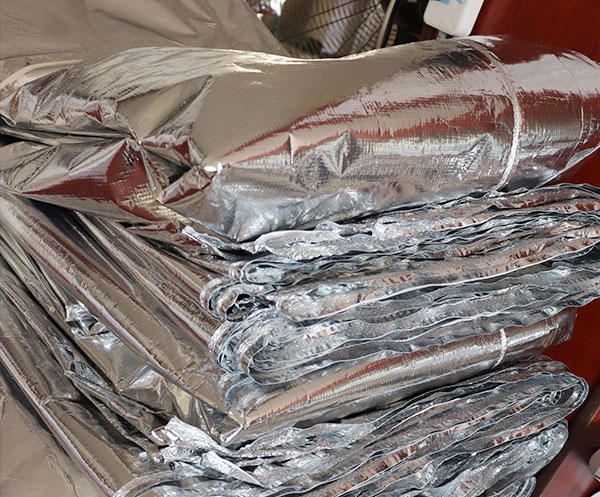
The aluminized woven bag acts as a "protective layer" for the packaging, wrapping around the inside or outside of the wooden frame. Its main functions are moisture protection, UV blocking, puncture resistance, and sealing. The bag material uses polypropylene (PP) woven fabric as the base material, and a 0.1-0.3μm thick aluminum film is formed on its surface through a vacuum aluminizing process, followed by heat sealing to create a sealed bag. There are two main ways to connect the bag to the wooden frame:
Internal Connection:The aluminized woven bag is pre-fixed to the inside of the wooden frame. After the goods are loaded, the bag is sealed (using heat sealing or rope tying). This method is suitable for goods requiring high sealing (such as powdered or granular goods), effectively preventing leakage and moisture absorption.
External Connection: The goods are first placed in the wooden frame, then the aluminized woven bag is placed over the frame. The bottom of the bag is fixed to the bottom tray, and the top is connected to the top beam via ropes or buckles. This method is convenient for loading and unloading and is suitable for goods with irregular shapes or those requiring frequent inspection.
In addition, the bag usually has pre-installed ventilation openings or observation windows (made of transparent PE Film). Ventilation openings prevent mold growth due to moisture and heat during storage (especially suitable for agricultural products and textiles), while observation windows allow for easy inspection of the goods without opening the packaging, reducing packaging damage.
(II) Material Performance: Multiple Functions Combined
The material performance of the large wooden crate with aluminized woven bag is determined by both the wooden frame and the aluminized woven bag body. The complementary performance advantages of both create a dual guarantee of "support + protection."
1. Core Performance of Wooden Frames
Compressive Strength: High-quality solid wood frames possess sufficient compressive strength to withstand the stacking of large goods, typically supporting 3-5 layers (each layer bearing 500-1000kg) with minimal deformation (≤3%), preventing damage to goods due to compression.
Corrosion Resistance: Wooden frames that have undergone drying treatment (moisture content controlled at 12%-15%) and anti-corrosion treatment (applied with environmentally friendly anti-corrosion coating) can withstand humid environments (relative humidity ≤85%) for 3-6 months without mold or rot, making them suitable for long-distance sea transport or storage in high-humidity areas.
Environmental friendliness: Frames use FSC-certified (Forest Stewardship Council) timber, and the anti-corrosion coating complies with EU REACH regulations, preventing environmental issues from affecting export (especially for regions with strict environmental requirements such as the EU and the US).
2. Core Performance of Aluminized Woven Bags
Moisture Resistance: The aluminized layer has excellent moisture barrier properties, with a water vapor transmission rate (WVTR) typically ≤5g/(m²・24h), far lower than ordinary PP woven bags (WVTR≥100g/(m²・24h)). This effectively prevents goods from getting damp during transportation (e.g., metal parts rusting, agricultural products spoiling);
UV Protection: The aluminum film can block over 95% of UV rays, preventing goods from aging, discoloring, or degrading due to prolonged exposure to sunlight (e.g., plastic products, rubber products, chemical raw materials);
Puncture Resistance: The PP woven fabric substrate has good tensile strength (longitudinal tensile strength ≥250N/5cm, transverse tensile strength ≥200N/5cm). Combined with the reinforcing effect of the aluminized layer, the puncture resistance of the bag is significantly improved, resisting minor collisions and friction during transportation and preventing leakage due to bag breakage;
Temperature Resistance: Aluminized woven bags can withstand temperatures from -30℃ to... It maintains stable performance within a temperature range of 60℃ and will not become brittle or softened due to temperature changes, making it suitable for transportation under different climatic conditions (such as winter in the north and summer in the south).
Large wooden crates with aluminum-coated Woven Bags serve as essential packaging components for heavy equipment, providing comprehensive protection during storage and transportation. With their unique composite structure and excellent performance, they are especially suitable for long-distance ocean shipping, multimodal transport, and harsh environment packaging. The following details their core features, advantages, application scenarios, and usage guidelines.
Aluminum-coated woven bags for large wooden crates typically use a multilayer composite structure, commonly VMPET (vacuum-metallized polyester film)/PE/woven fabric/PE four-layer composition. Thickness can be customized according to equipment weight, generally ranging from 0.13–0.18 mm, with special requirements allowing up to 0.2 mm or more. Key performance features include:
Exceptional Barrier Properties: The aluminum layer effectively blocks oxygen, water vapor, and UV radiation. Oxygen barrier performance is 10–15 times higher than ordinary woven bags, while water vapor transmission rates drop to less than 1/20 of standard bags. This prevents corrosion and rust of heavy equipment metal parts, especially in high-humidity environments during overseas transport.
High Mechanical Strength: Using high-density polyethylene or polypropylene woven fabric as a base, tensile strength reaches 30–50 N/mm², with excellent puncture and tear resistance. It withstands compression, friction, and impact during handling. The aluminum layer enhances surface wear resistance, extending packaging lifespan by 30–50%.
Heat Insulation and Anti-Static Properties: The aluminum layer has a low thermal radiation rate (0.03–0.05) and a thermal conductivity 40–60% lower than ordinary woven bags, protecting equipment from temperature fluctuations. Surface resistivity reaches 10^6–10^9 Ω, preventing static accumulation and safeguarding sensitive electronic components.
Sealing and Adaptability: Excellent heat-sealing properties allow vacuum sealing. When combined with large wooden crates, it forms a fully enclosed protective space that prevents contamination. Bags can be customized to any size, compatible with various crate specifications, and manufactured as flat, three-dimensional, or irregular shapes.
Cooperative Protection: Paired with large wooden crates, the crate provides structural compression and impact resistance, while the aluminum-coated woven bag serves as an inner liner for moisture, rust, and oxygen protection. Together, they withstand stacking pressure, salt spray, temperature fluctuations, and other challenging transport conditions.
Cost Reduction: Compared to pure aluminum foil packaging, aluminum-coated woven bags are lighter and less expensive, reducing overall crate weight and transportation costs. They are also recyclable, supporting environmental and sustainability goals.
Versatile Application: Suitable for packaging heavy machinery, metallurgical equipment, power equipment, and precision machine tools. They provide stable protection for domestic land transport, international shipping, and rail transport, particularly for high-precision equipment requiring vacuum packaging.
Determine bag size and thickness based on equipment dimensions, weight, and transport environment. Use heat sealing to ensure airtightness, and check the bag integrity during vacuum packaging. When used with wooden crates, add cushioning materials such as EPE foam between the bag and equipment to enhance impact resistance further.
Frequently Asked Questions (FAQs)
1.What is the maximum load-bearing capacity of large wooden crate aluminized Woven Bags?
Our aluminized woven bags use a multi-layer composite structure. The thickness can be customized according to the equipment weight, generally between 0.13–0.18mm, and can withstand heavy equipment weighing several tons. Through a high-density polyethylene or polypropylene woven fabric base and an aluminized reinforcing layer, it ensures no damage during transportation, loading, unloading, and stacking, while also possessing excellent tear and puncture resistance.
2.Can aluminized woven bags maintain moisture and rust prevention during sea freight or long-distance transport?
Yes. The aluminized layer has extremely high oxygen barrier and waterproof performance, with water vapor transmission rate more than 20 times lower than ordinary woven bags, effectively preventing metal parts from rusting or oxidizing. It provides long-term stable protection in cross-border sea freight, rail transport, and multimodal transport environments.
3.Can large wooden crate aluminized woven bags be customized according to equipment dimensions?
Absolutely. We support customization of bag size, thickness, and shape according to equipment specifications, including flat bags, stand-up pouches, and irregularly shaped bags. Customized production ensures the bag fits perfectly against the wooden crate and equipment surface, achieving comprehensive protection against airtightness, dust, moisture, and static electricity.
4.What are the advantages of using aluminized woven bags in conjunction with wooden crates?
The wooden crate provides structural support against pressure and impact, while the aluminized woven bag acts as a lining, blocking moisture, oxygen, and contaminants. The combination forms a dual protection system of "hard shell + lining," effectively coping with stacking pressure, temperature changes, and harsh transportation environments, while reducing overall packaging weight and saving transportation costs.
5.What is the lifespan and reusability of aluminized woven bags?
Our aluminized woven bags have a wear-resistant and tear-resistant surface and can typically be reused 2-5 times. The specific lifespan depends on the equipment weight and transportation conditions. Heat sealing or vacuum packaging maintains the airtightness and protective performance, extending the bag's lifespan while meeting environmental protection and sustainable development requirements.
This website uses cookies to ensure you get the best experience on our website.
 Español
 Pусский
 Deutsch
 العربية



 WhatsApp
 Phone
Phone