

In today's rapidly developing packaging industry, vacuum-metallized Woven Bags, with their unique structure and performance advantages, are gradually becoming an important choice for product packaging across various industries. This packaging material cleverly combines the mechanical properties of woven plastic fabric with the barrier properties of vacuum metallization technology, creating a packaging product that is both sturdy and durable, and offers excellent protection. From its production process to its application practices, from its performance characteristics to its future development, this packaging material demonstrates unique value and potential.
I. Production Process and Technical Characteristics
The production of Vacuum-metallized woven bags is a precision manufacturing process integrating mechanical engineering, materials science, and vacuum technology. Production begins with the preparation of the base material, typically using polypropylene or polyethylene as raw material. This material is melted and plasticized at a specific temperature using an extruder, and then passed through a die to form a continuous film. These films are then cut into flat filaments of a specific width and subjected to directional stretching in a constant temperature and humidity environment, causing the molecular chains to align orderly along the stretching direction, thereby achieving higher tensile strength. The width and thickness of the flat filaments are precisely controlled according to packaging requirements, with common specifications ranging from 0.025 to 0.045 mm.
The weaving process is completed using advanced circular looms or shuttle looms. Circular looms achieve continuous circular weaving through the coordinated operation of the warp frame, shuttle, and take-up device, resulting in high production efficiency. Shuttle looms, on the other hand, use a reciprocating weft insertion method, producing a denser and smoother fabric. During the weaving process, a precise tension control system ensures even tension of the warp and weft threads, preventing unevenness. The fabric density is adjusted according to usage requirements, typically controlled within the range of 40-60 threads per square inch. This density ensures sufficient strength without excessively increasing material weight.
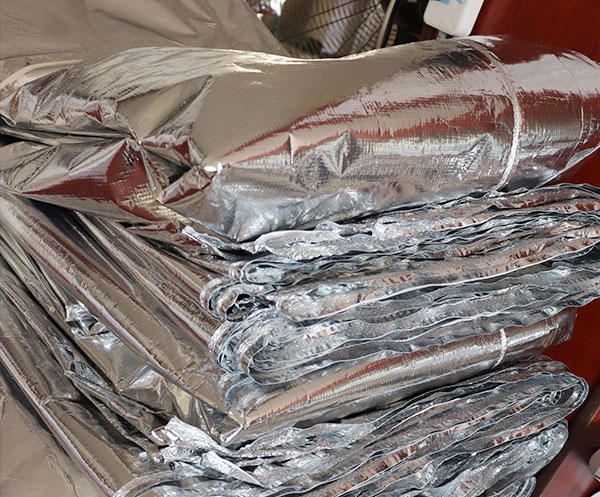
The vacuum metallization process is the essence of the entire production process. In highly automated vacuum coating equipment, aluminum wire evaporates in a high-temperature vacuum environment of 1400-1500 degrees Celsius, and aluminum atoms are uniformly deposited as gaseous particles on the surface of the woven substrate. This process requires precise control of parameters such as vacuum level, evaporation temperature, and deposition time; the vacuum level is typically maintained above 10⁻² Pa. Modern metallization equipment is equipped with an online monitoring system to monitor the thickness and uniformity of the metallized layer in real time. The thickness of the aluminized layer is generally controlled between 400-600 angstroms. This thickness range has been verified through extensive experimentation, ensuring good barrier performance without excessively affecting the material's flexibility.
Post-processing is equally important. The aluminized material requires curing to ensure a stronger bond between the aluminum layer and the substrate. Depending on the application requirements, further processing may include antistatic treatment, UV protection, or printing. Antistatic treatment is achieved by adding a special coating, effectively preventing static electricity buildup during packaging; UV protection involves adding UV absorbers to extend the material's lifespan in outdoor environments. Each process has strict quality control points, using visual inspection systems, thickness gauges, and other equipment to ensure the final product meets design requirements.
II. Material Structure and Performance Characteristics
Vacuum-metallized woven bags employ a multi-layer composite structure, with each layer having a specific function. The substrate layer is a biaxially stretched plastic woven fabric, giving the material high tensile strength and tear resistance. Test data shows that standard-sized vacuum-metallized woven bags can achieve a longitudinal tensile strength of over 35 MPa and a transverse tensile strength of approximately 30 MPa. This mechanical property enables it to withstand various external forces during loading, unloading, and transportation. The woven fabric's structural design also considers stress distribution during use, with special reinforcement at key areas such as seams and edges.
The functional layer is a metal layer formed through a vacuum aluminum plating process. This extremely thin aluminum film constitutes a continuous and dense barrier, effectively blocking the passage of light, oxygen, and water vapor. Experimental data shows that its water vapor transmission rate can be controlled below 1.0 g/m²·24h, and its oxygen transmission rate does not exceed 0.5 cm³/m²·24h. This barrier performance provides a good protective environment for the contents, making it particularly suitable for products sensitive to humidity and oxygen. The uniformity of the aluminum plating layer directly affects the barrier effect; modern production processes ensure that the thickness deviation of the aluminum plating layer is controlled within ±5%.
The surface treatment layer depends on the application requirements. Common treatments include applying a protective varnish, corona treatment, or adding a functional coating. These treatments not only enhance the material's durability but also improve its printability and performance. For example, certain specially formulated protective varnishes can improve the abrasion resistance of materials, enabling them to withstand more frequent handling and friction; corona treatment can improve the adhesion of the material surface, facilitating high-quality printing.
The comprehensive performance of the material is also reflected in its environmental adaptability. Accelerated aging tests verified that after 1000 hours of UV irradiation, the material retains over 80% of its main performance indicators. Temperature adaptability tests show that the material maintains stable performance within a temperature range of -40℃ to 75℃. These characteristics allow it to adapt to different storage and transportation environments. Furthermore, the material has excellent chemical resistance, resisting the corrosion of most acids, alkalis, and salts.
III. Application Areas and Practical Value
In the chemical industry, vacuum-metallized woven bags demonstrate significant value. Plastic granules, fertilizers, and other chemical products have high requirements for the moisture-proof and strength properties of their packaging. This packaging material effectively prevents products from becoming damp and clumping, and can withstand various stresses during stacking and transportation. A chemical company reported that, under the same storage conditions, products packaged in vacuum-metallized woven bags maintained their original quality after six months, with a product loss rate reduced by approximately 30%, resulting in significantly improved customer satisfaction.
The grain and feed industries also benefit from this packaging. Grain products have strict requirements for storage environments, needing protection against moisture, insects, and mold. The barrier properties of vacuum-metallized woven bags provide ideal conditions for grain storage. Actual usage data shows that grain packaged in this way, stored for 180 days in an environment with 85% relative humidity, only increased its moisture content by 0.3%, far lower than the 2.1% increase in ordinary packaging. This superior moisture-proof performance is of great significance for grain reserves and international trade, effectively reducing losses caused by mold.
Applications in the building materials industry are also quite representative. Cement, gypsum, and other building materials are prone to hardening due to moisture during storage, affecting their performance. This packaging material can keep products dry while possessing sufficient strength to withstand stacking pressure. Its durability advantage is particularly evident in scenarios with multiple logistics links. After adopting this packaging method, the quality stability of building materials products has been significantly improved, and the user complaint rate has decreased markedly. Real-world examples show that after a building materials company adopted vacuum-metallized woven bags, the product damage rate during transportation dropped from 5% to below 0.8%.
This packaging material also shows promising application prospects in emerging fields. In the photovoltaic industry, it is used to package solar panel modules; in the lithium battery industry, it is used for packaging electrode materials; and in the pharmaceutical field, it is used for transporting some moisture-sensitive raw materials. Its designability allows it to be adjusted according to different usage needs by changing the material thickness, the density of the aluminized layer, or adding special functional layers to meet the specific requirements of particular industries. As its application scope expands, the value of this packaging material will become even more apparent.
Vacuum aluminum-coated Woven Bags, with their excellent overall performance, have become the preferred packaging solution for various export products. They are especially suitable for precision machinery, electronic components, chemical materials, and other items that require high-level protection, providing comprehensive security for goods during international transportation.
Vacuum Aluminum-coated woven bags are typically made using a composite of polypropylene woven fabric, aluminum foil, and polyethylene, with some high-end products featuring four-layer structures. They offer superior barrier properties, effectively blocking moisture, oxygen, and UV light. When vacuum-sealed, the internal humidity remains extremely low, preventing products from dampness, oxidation, rust, or deterioration. The aluminum foil layer reflects heat radiation, providing excellent insulation to withstand high temperatures and sun exposure during sea transport, protecting temperature-sensitive export goods. Meanwhile, the woven fabric base gives the bag strong tensile, puncture, and tear resistance, safeguarding against pressure, collisions, and sharp objects during transportation, reducing the risk of package damage and ensuring cargo integrity.
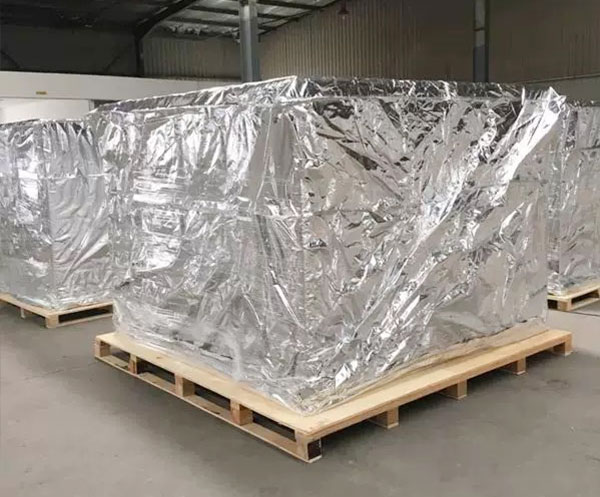
Export packaging must meet standards of multiple countries. Vacuum aluminum-coated woven bags can pass authoritative inspections such as SGS and comply with EU, North American, and other regional packaging regulations, avoiding returns caused by non-compliance. They can be vacuum-sealed, have excellent heat-sealing performance, and are leak-resistant after sealing. Bags can be customized to fit the size and shape of export goods, from large machinery to small precision components, with no minimum order quantity, making them suitable for both small trial orders and large-scale shipments. Compared with pure Aluminum Foil Bags, they are more cost-effective and lighter in weight, reducing shipping costs, while the metallic finish enhances packaging appearance, helping products establish a premium image in overseas markets.
The aluminum foil layer is conductive, dissipating static electricity to reduce dust accumulation and safety risks, making it suitable for packaging electronics, chemicals, and other static-sensitive products. Some products are recyclable, aligning with environmental trends and meeting overseas demand for green packaging. Whether for long-distance ocean shipping or complex multi-stage logistics, vacuum aluminum-coated woven bags provide reliable protection for export goods, making them the optimal choice for export packaging.
Frequently Asked Questions (FAQs)
1. Which export products are suitable for vacuum metallized Woven Bags?
Our vacuum metallized woven bags are suitable for export products that require high levels of moisture protection, oxidation protection, and anti-static properties, such as precision machinery, electronic components, chemical raw materials, and food products. Whether it's large equipment or small precision parts, the bags can be customized to size, ensuring safe and reliable packaging.
2. How effective is the bag's protective performance, and can it withstand long-distance sea shipping?
The vacuum metallized woven bags feature a multi-layer composite structure. The aluminum film blocks moisture, oxygen, and UV rays, while also reflecting thermal radiation, providing excellent insulation. The woven fabric base material is tear-resistant and puncture-resistant, able to withstand transportation compression and collisions, ensuring that goods remain intact during long-distance sea shipping and complex logistics.
3. Do they meet export standards, and are test reports available?
Our vacuum metallized woven bags can be tested by authoritative institutions such as SGS and comply with packaging regulations in the EU, North America, and other export regions. Relevant compliance test reports can be provided to customers, ensuring smooth export and avoiding returns due to non-compliant packaging.
4. Can the product be customized in size, and what are the minimum order quantity requirements?
We can customize bags according to the size, shape, and quantity of the customer's goods. There is no minimum order quantity, supporting both small-batch trial orders and large-volume export orders, flexibly meeting the needs of different customers and export scenarios.
5. Are the bags environmentally friendly after use, and can they be recycled?
Some vacuum metallized woven bag products are recyclable, aligning with international environmental trends. The conductive aluminum film releases static electricity, protecting product safety and reducing environmental burden, meeting the overseas market's demand for green packaging.
This website uses cookies to ensure you get the best experience on our website.
 Español
 Pусский
 Deutsch
 العربية



 WhatsApp
 Phone
Phone