

I. Core Characteristics of Vacuum Packaging with Aluminum Foil in Wooden Crates for Equipment Shipping
(I) Multi-dimensional Environmental Barrier: Resisting Complex Corrosion During Shipping
The core advantage of vacuum packaging with aluminum foil in wooden crates for equipment shipping lies in its comprehensive barrier capability against the harsh environment of maritime transport. The inner aluminum foil vacuum bag adopts a multi-layer composite structure (such as PET/AL/PE, PA/AL/PE). The oxygen permeability of the aluminum foil layer is as low as 0.1cc/(m²・24h・atm), and the water vapor permeability is less than 1g/(m²・24h), completely isolating it from the high humidity air (the relative humidity inside the hold often reaches 70%-90%) and salt spray during sea transport. The chloride ions contained in salt spray accelerate the corrosion of metal parts, while the dense structure of the Aluminum Foil Bag can prevent salt spray penetration. Combined with vacuum sealing technology, the oxygen content inside the bag is reduced to below 1%, further inhibiting metal oxidation. For example, the cast iron guide rails of CNC machine tools, after this packaging, have a corrosion rate during sea transport reduced from 15% with traditional packaging to below 1%. Meanwhile, the aluminum foil layer can block the intrusion of external microorganisms (such as mold), preventing the internal electrical components and rubber parts of the equipment from failing due to mold growth. For equipment requiring long-term sea transport (such as trans-Pacific transport requiring 30-45 days), the aluminum foil vacuum bag can also contain a desiccant (such as montmorillonite desiccant, with a moisture absorption rate ≥20%) to further control the humidity inside the bag (maintaining a relative humidity ≤30%), ensuring that the core components of the equipment (such as circuit boards and precision bearings) are in a dry environment throughout the transportation process, avoiding moisture-induced short circuits or jamming.
(II) High-strength physical protection: Coping with the impact of sea turbulence
During sea transport, physical impacts such as ship turbulence, loading and unloading collisions, and stacking compression can easily cause deformation of the outer shell of precision equipment and displacement of internal components. The outer wooden crate, vacuum-packed with aluminum foil for equipment transport, features a customized high-strength structure. It is made of solid wood (pine, fir) or composite boards (such as plywood), with the board thickness adjusted according to the equipment weight: 25-35mm for 1-5 ton equipment, and 35-50mm for 5-10 ton equipment, ensuring load-bearing capacity and impact resistance. The crate corners are reinforced with metal corner protectors (≥2mm thickness), and the bottom features reinforcing ribs (≤150mm spacing). In a 1.8-meter drop test from six sides, the crate's integrity rate reaches over 98%, effectively cushioning impacts and protecting the internal equipment.
The inner aluminum foil vacuum bag fits tightly against the equipment, forming a "flexible support" after vacuum sealing. This disperses external impact forces, preventing direct collision between the equipment and the crate. For example, the precision detectors of medical CT equipment, tightly wrapped in aluminum foil vacuum bags, can withstand vibrations during transport (frequency 5-50Hz, acceleration ≤2g), preventing pixel shift that could affect accuracy. Furthermore, the interior of the wooden crate can be customized with EVA cushioning foam or pearl cotton according to the shape of the equipment to fill the gaps between the equipment and the crate, further improving shock resistance and ensuring the equipment remains stable throughout the sea voyage.
(III) Compliance and Adaptability: Meeting International Transportation Standards
International equipment shipping must comply with the packaging standards and environmental requirements of various countries. Wooden crates with Aluminum foil vacuum packaging offer significant advantages in terms of compliance. The wooden crates use boards that meet the ISPM 15 international wood packaging quarantine standard and undergo heat treatment (temperature ≥56℃, duration 30 minutes) or fumigation to prevent the carrying of harmful organisms. No additional quarantine certificates are required for passage through major ports worldwide, reducing customs clearance delays. The surface of the wooden crate is clearly marked with shipping markings (such as moisture-proof, anti-tipping, center of gravity), conforming to the ISO 780 packaging marking standard, facilitating loading and unloading operations and reducing the risk of human-caused damage.
The aluminum foil vacuum bags are made of food-grade or industrial-grade safety materials. The inner PE Film complies with GB 4806.7-2016 and FDA 21 CFR 177.1520 standards, ensuring no harmful substance migration upon contact with equipment. This makes them particularly suitable for applications with high material safety requirements, such as medical equipment and food processing equipment. For flammable and explosive equipment (such as certain industrial laser equipment), an antistatic layer can be added to the aluminum foil vacuum bags, with a surface resistance controlled at 10^6-10^11 Ω, meeting the GB 12476.1-2021 antistatic standard, thus preventing safety accidents caused by electrostatic discharge during sea transport.
(IV) Convenience and Traceability: Improving Transportation Management Efficiency
The aluminum foil vacuum packaging in the wooden crates for equipment sea transport has been optimized for ease of use and traceability. The wooden crates feature a detachable structure and are equipped with quick-connect fittings (such as clips and bolts), allowing for rapid disassembly upon arrival at the destination and reducing preparation time before equipment installation. The aluminum foil vacuum bags have pre-installed inspection ports and vacuum valves. If equipment inspection is required en route, the valves can be opened and the vacuum re-exposed without damaging the overall packaging. For example, when semiconductor manufacturing equipment needs to be inspected at a transit port, the inspection can be completed through the inspection port, avoiding the cumbersome process of unpacking and repackaging traditional packaging.
For traceability, RFID tags or QR codes are affixed to the surface of the wooden crates, recording information such as equipment name, model, weight, port of origin, port of destination, and transportation time. IoT technology enables full-process positioning and status monitoring (such as real-time monitoring of internal temperature and humidity). Enterprises can view the equipment's transportation location and environmental parameters at any time through the back-end system, responding promptly to abnormal situations (such as excessive humidity in the cargo hold), improving the transparency and efficiency of transportation management.
II. Key Production Processes for Wooden Crates and Aluminum Foil Vacuum Packaging for Equipment Sea Freight
(I) Raw Material Selection: Matching Sea Freight Protection Needs
The quality of raw materials directly determines the packaging protection effect and requires strict selection based on the characteristics of the sea freight environment. The wooden crate panels are made of solid wood or plywood with a moisture content of 12%-18%. Solid wood must undergo degreasing and drying treatment to prevent warping and cracking due to humidity changes during sea transport. Plywood must meet GB/T 11718-2021 standards, with a static bending strength ≥18MPa and internal bond strength ≥0.7MPa to ensure load-bearing capacity and impact resistance. Metal corner protectors and reinforcing ribs are made of galvanized steel with a thickness ≥2mm, and rust resistance meets GB/T 13912-2022 standards to prevent corrosion from sea salt spray.
The substrate for aluminum foil vacuum bags must possess high barrier properties and puncture resistance: aluminum foil thickness 9-12μm, purity ≥99.5%, surface free of pinholes (pinhole count ≤1/m²), inspected roll by roll using a light inspection method; outer PET film thickness 15-25μm, tensile strength ≥180MPa, temperature resistance ≥120℃, able to withstand the high temperatures inside seagoing vessels (summer temperatures can reach above 50℃); inner PE film thickness 80-120μm, heat-sealing strength ≥30N/15mm, ensuring a tight vacuum seal; solvent-free polyurethane adhesive used, bonding strength ≥5N/15mm, resistant to seawater corrosion, preventing delamination. Auxiliary materials such as desiccants use montmorillonite or silica gel, moisture absorption ≥20%, compliant with RoHS environmental standards; cushioning material uses EVA foam, density ≥38kg/m³, resilience ≥70%, ensuring shock absorption.
(II) Customized Wooden Crate Manufacturing: Adapting to Equipment Size and Weight
The wooden crates for equipment shipped by sea need to be customized according to the equipment's size, weight, and shape. Core processes include size design, board cutting, and structural reinforcement. Size design must allow space for equipment installation and cushioning materials; the internal dimensions of the crate should be 50-100mm larger than the equipment dimensions to ensure adequate cushioning. For irregularly shaped equipment (such as large motors), a custom-designed crate is used. 3D scanning is used to obtain the equipment's shape data, and a custom-made crate structure is created to fit the equipment perfectly, preventing swaying.
The boards are cut using CNC cutting equipment, with dimensional deviations controlled within ±1mm to ensure splicing accuracy. Splicing employs a combination of mortise and tenon joints and bolt reinforcement, with mortise and tenon gaps ≤0.5mm. M8-M12 galvanized bolts are used, with a spacing ≤200mm, enhancing connection strength. The bottom of the wooden crate features a "well"-shaped reinforcing rib, with a width ≥80mm and a thickness consistent with the board material, improving load-bearing capacity; the bottom of the crate for a 10-ton device can support over 15 tons. Metal corner protectors are added to the edges and corners, secured with rivets (rivet spacing ≤50mm) and rivet diameter ≥5mm, enhancing impact resistance. The crate lid has a detachable structure, equipped with hinges and locks for easy loading, unloading, and inspection of the equipment. Furthermore, the wooden crate must have ventilation holes (10-15mm in diameter) to prevent condensation due to temperature differences during sea transport; dust filters are installed in the ventilation holes to prevent impurities from entering.
(III) Aluminum Foil Vacuum Bag Manufacturing and Vacuum Sealing Process
The manufacturing of aluminum foil vacuum bags involves lamination, bag making, and valve installation to ensure barrier properties and a tight seal. The lamination process uses a dry lamination method, with drying temperature controlled in three stages: 50-60℃ to evaporate low-boiling-point solvents, 70-80℃ to remove residual solvents, and 60-65℃ to prevent film shrinkage. The total drying time is 3-5 minutes, and the total residual solvent amount is ≤5mg/m². The lamination pressure is 0.3-0.5MPa to ensure a tight bond between the aluminum foil and the plastic film, free of air bubbles. The lamination speed is 30-60m/min, balancing efficiency and quality. Bag making uses CNC bag-making equipment, customizing the bag body according to the internal dimensions of the wooden crate. The heat-sealing temperature is 180-220℃, the heat-sealing pressure is 0.4-0.6MPa, the heat-sealing time is 1-2 seconds, and the heat-sealed edge width is 10-15mm, ensuring a sealing strength ≥35N/15mm.
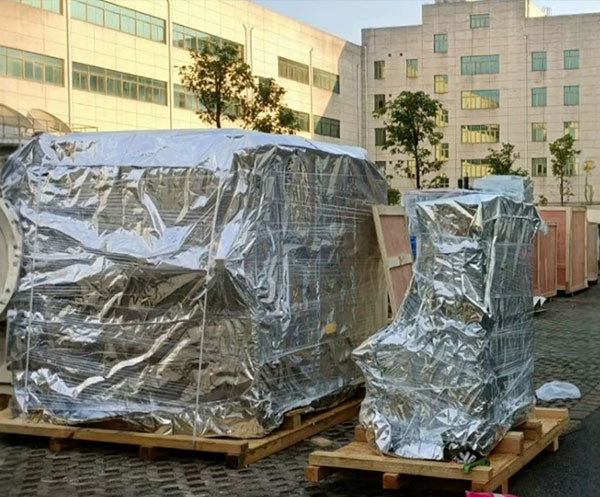
The bag is equipped with a vacuum valve (made of food-grade PP) and an inspection port. The valve is fixed by hot-press welding, and the weld is tested for air tightness (inflated to 0.02-0.03 MPa, held for 60 seconds without leakage). The inspection port is equipped with a sealing cap, using a threaded connection, and a rubber sealing ring is installed inside the sealing cap to ensure a tight seal after closing. The vacuum sealing process must be carried out in a clean environment (air cleanliness level 100,000). After placing the equipment in the aluminum foil bag, place a desiccant (500-1000g per cubic meter of space), and use a vacuum device to extract the air from the bag. After the vacuum degree reaches -0.09 MPa, close the valve to complete the seal. After sealing, it must be left to stand for 24 hours, and the vacuum degree drop must be ≤0.005 MPa to ensure no leakage.
(IV) Overall Assembly and Quality Inspection
The overall assembly of the equipment in the aluminum foil vacuum packaging in the wooden crate for sea transport must ensure that all components work together for protection. The core processes include laying cushioning materials, fixing the equipment, and sealing the wooden crate. The cushioning material is laid out using a "top, bottom, left, and right wrapping" method. A 50-100mm thick layer of EVA foam is placed at the bottom of the equipment, surrounded by pearl cotton, and a cushioning pad is placed on top to ensure no direct contact between the equipment and the wooden crate. For protruding parts of the equipment (such as the motor shaft), customized foam sleeves are used to prevent damage from impacts. The equipment is secured to the reinforcing ribs at the bottom of the wooden crate using nylon cable ties or bolts. The cable ties must have a strength of ≥500N, and anti-loosening nuts are used to prevent loosening due to sea turbulence.
After assembly, a comprehensive quality inspection is conducted: 1. Physical performance testing: Drop test (1.8 meters height, six-sided drop) and stacking test (3 meters height stacked for 24 hours) are performed to check for damage to the wooden crate and displacement of the equipment; 2. Barrier performance testing: The water vapor transmission rate (≤1g/(m²・24h)) and oxygen transmission rate (≤0.1cc/(m²・24h・atm)) of the aluminum foil bag are tested to ensure barrier effect; 3. Vacuum sealing test: Vacuum is drawn to -0.09MPa and maintained for 48 hours, with a vacuum decrease of ≤0.005MPa; 4. Compliance testing: The ISPM 15 marking and shipping markings on the wooden crate are checked, and the material of the aluminum foil bag is tested to ensure compliance with environmental standards. Only after passing the tests can the product leave the factory, ensuring that the packaging meets the requirements for marine protection.
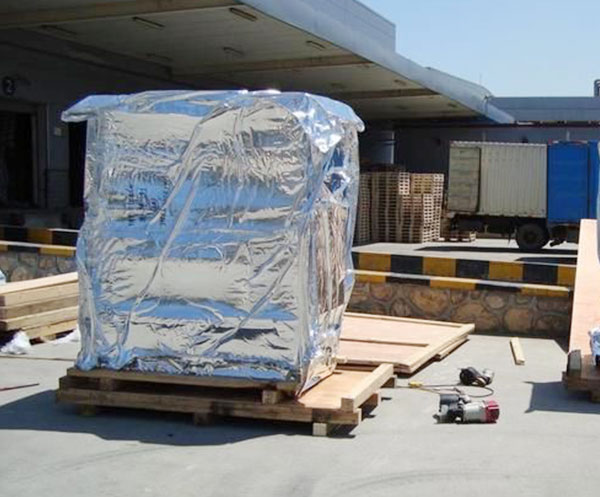
III. Multi-Field Application Scenarios of Wooden Crates and Aluminum Foil Vacuum Packaging for Equipment Shipping
(I) Industrial Machinery and Equipment: Ensuring the Safety of Heavy Equipment Transportation
Industrial machinery and equipment (such as CNC machine tools, injection molding machines, and large motors) are large, heavy, and highly precise, making them susceptible to impact and corrosion during sea transport. Using wooden crates and aluminum foil vacuum packaging for equipment shipping allows for customized crate strength based on equipment weight. For example, a 3-ton CNC machine tool can use a 30mm thick plywood crate with bottom reinforcing ribs capable of supporting 5 tons, and metal corner protectors to withstand loading and unloading collisions. The aluminum foil vacuum bags isolate salt spray and moisture, and, combined with desiccants, keep the inside of the bags dry, preventing rust on machine tool guideways and short circuits in electrical cabinets due to moisture. A machine tool company shipped equipment from China to Germany using this packaging method; the equipment damage rate upon arrival decreased from 8% with traditional packaging to 0.5%, and installation and commissioning time was reduced by 30%.
For large Production line equipment (such as automotive stamping production lines), a modular packaging and overall labeling approach is adopted. The equipment is divided into multiple modules, each corresponding to a customized wooden crate and aluminum foil bag. The wooden crate surface is marked with the module number and installation location for easy assembly at the destination. The aluminum foil bag contains a parts list and a moisture-proof indicator card, with real-time humidity monitoring to ensure that precision components (such as stamping dies) are not damaged during sea transport. This packaging method not only reduces transportation losses but also improves port loading and unloading efficiency and reduces warehouse space occupation.
(II) Medical Precision Equipment: Ensuring Stable Equipment Performance
Medical precision equipment (such as CT scanners, MRI machines, and surgical robots) has extremely high requirements for the transportation environment. Even slight vibrations or excessive humidity can affect the equipment's precision and performance. Vacuum-packed wooden crates with aluminum foil provide professional protection for the equipment during sea freight. The crates are lined with custom-made EVA cushioning foam, with a density ≥45kg/m³, which absorbs vibrations during transport and prevents displacement of CT scanner detectors and MRI magnets. The vacuum-sealed aluminum foil bags maintain humidity levels between 25% and 30%, preventing short circuits in internal circuit boards and aging of rubber seals.
A medical equipment company shipped an MRI scanner from China to Australia over 40 days. Using this packaging, the equipment arrived with an accuracy error ≤0.1mm, meeting clinical standards and requiring no recalibration. The humidity indicator card inside the aluminum foil bags showed a humidity level ≤30% throughout the journey, with no signs of mold growth. Furthermore, the crates feature a detachable structure and are equipped with dedicated lifting points, facilitating on-site unloading and installation at the hospital and reducing the risk of damage during handling.
(III) Electronic Information Equipment: Protecting Precision Components from Damage
The internal components of electronic information equipment (such as server clusters, semiconductor lithography machines, and precision sensors) are extremely sensitive to static electricity, moisture, and impact, requiring comprehensive protection during sea transport. For equipment transport, the aluminum foil bags in the wooden crates with aluminum foil vacuum packaging have an added antistatic layer, with a surface resistance of 10^6-10^11 Ω, to prevent electrostatic discharge from damaging server chips and lithography machine lenses. The inside of the wooden crate is lined with antistatic cushioning material (such as antistatic pearl cotton), with a surface resistance of 10^6-10^9 Ω, further enhancing the antistatic effect.
For ultra-precision equipment such as semiconductor lithography machines (with nanometer-level precision), a "double-layer aluminum foil vacuum bag + customized cushioning" design is adopted. The inner aluminum foil bag directly wraps the equipment, while the outer aluminum foil bag is filled with high-density foam between it and the wooden crate, forming a double barrier and cushioning. During sea transport, RFID tags monitor the temperature, humidity, and vibration parameters inside the crate in real time. Once the back-end system detects an anomaly (such as excessive vibration), it immediately notifies the ship to adjust the transport status. A semiconductor company used this packaging to ship lithography machines to the Netherlands. Upon arrival, the equipment achieved a 100% pass rate in performance testing, with no issues reported.
Seaworthy wooden crate and Aluminum foil vacuum packaging Solutions for Precision Equipment
The seaworthy wooden crate and aluminum foil vacuum packaging solution for precision equipment combines the load-bearing protection of wooden crates with the barrier advantages of aluminum foil vacuum packaging. This high-end sea transport solution is specially designed for delicate, high-value items such as precision electromechanical equipment, optical instruments, and electronic components, providing comprehensive protection against the harsh conditions of long-distance ocean transport, including salt spray, high humidity, compression, impact, and UV exposure, ensuring the safe transit of equipment throughout the shipping process.
The solution features a composite protective structure of an inner aluminum foil vacuum bag + outer seaworthy wooden crate. The inner aluminum foil vacuum bag is made of multi-layer composite materials, with the aluminum foil layer forming a dense barrier that effectively blocks moisture, oxygen, and ultraviolet rays. Coupled with vacuum sealing, all air is removed from the bag, creating a dry, oxygen-free sealed environment that prevents corrosion, moisture damage, and performance degradation of components. The Aluminum Foil Bag also offers excellent anti-static and dust-proof properties, preventing static accumulation and dust contamination of sensitive parts. The outer wooden crate, made from high-strength plywood and reinforced for durability, provides outstanding compression resistance, safely bearing stacked loads and handling impacts during loading and unloading, preventing equipment movement or deformation.
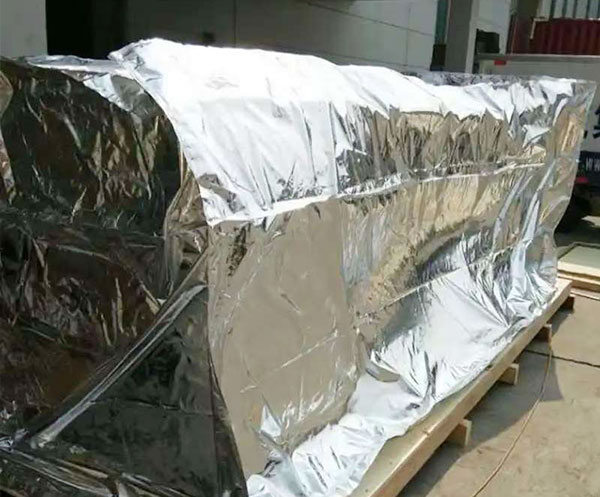
This solution offers high adaptability, with wooden crate sizes and aluminum foil bag dimensions customizable to match the specific shape and size of the precision equipment. Additional cushioning materials such as foam or EPE pearl cotton can be added inside the crate to enhance shock absorption. The wooden crate complies with international sea transport fumigation-free regulations, and the aluminum foil packaging meets environmental and export packaging standards, avoiding compliance risks. The compact structure also reduces transport volume and cost, making it an ideal choice for precision equipment sea transport that balances professional protection, regulatory compliance, and custom adaptability.
Frequently Asked Questions (FAQs)
1. How much stacking pressure and transportation impact can this sea freight wooden crate Aluminum foil vacuum packaging withstand?
Our packaging solution uses high-strength plywood crates and multi-layer composite aluminum foil vacuum bags. Through special reinforcement and precision design, it can withstand the pressure of multiple stacks and the impact and collision during long-distance sea freight loading and unloading, effectively preventing equipment displacement, damage, or deformation, ensuring the safe arrival of precision equipment at its destination.
2. How do aluminum foil vacuum bags guarantee moisture and oxidation prevention?
The aluminum foil vacuum bags use a multi-layer composite structure. The aluminum foil layers form a dense barrier that effectively isolates moisture, oxygen, and ultraviolet rays. Combined with vacuum sealing technology, all air inside the bag is completely expelled, creating a dry, oxygen-free environment, preventing equipment from becoming damp, oxidized, or experiencing performance degradation at the source.
3. Can the packaging be customized according to different equipment sizes?
Absolutely. We offer customization services, flexibly designing wooden crate specifications and Aluminum Foil Bag sizes according to the size, shape, and weight of precision equipment or fragile goods. Internally, cushioning materials such as foam and pearl cotton can be added to enhance shock absorption and provide comprehensive protection.
4. Does this packaging solution comply with international maritime shipping and export regulations?
Yes. The wooden crate meets the international maritime fumigation-free standard (ISPM15), and the aluminum foil vacuum packaging meets environmental protection and export packaging requirements, avoiding return shipments and compliance risks. The overall packaging structure is compact, complying with regulations while facilitating logistics operations and reducing transportation costs.
5. What types of precision equipment or high-value goods is this packaging suitable for?
This solution is suitable for precision electromechanical equipment, optical instruments, electronic components, hardware accessories, and other fragile, high-value goods, especially suitable for international ocean shipping. Whether it's small to medium-sized machinery or complex, irregularly shaped equipment, it provides stable protection throughout the entire process, ensuring the safety and reliability of the goods.
This website uses cookies to ensure you get the best experience on our website.
 Español
 Pусский
 Deutsch
 العربية



 WhatsApp
 Phone
Phone