


I. The Specificity and Technical Requirements of Machine Packaging
The packaging of industrial machinery and equipment needs to address multiple complex challenges. First, machinery and equipment typically have high self-weight and complex structural forms. Taking a machining center as an example, its weight can range from several tons to tens of tons, and it includes precision guide rails, spindle systems, and other vibration-sensitive components. Data shows that vibration and impact during transportation are one of the main reasons for the loss of machine precision, accounting for up to 42% of early equipment failures.
Environmental factors have a particularly significant impact on machinery and equipment. Metal structural components begin to undergo electrochemical corrosion in environments with humidity exceeding 65%, especially in critical areas such as mating surfaces and precision guide rails. Temperature fluctuations are equally important; when the ambient temperature changes drastically, condensation may occur inside the machine, leading to short circuits in electrical components or corrosion of metal surfaces.
The complex shape of the machine poses special requirements for packaging design. Most industrial equipment has irregular shapes, including protruding control panels, exposed hydraulic lines, and electrical interfaces. These parts are easily damaged during loading, unloading, and transportation, requiring targeted protective measures. At the same time, the machine's center of gravity, lifting points, and support points must be precisely considered in the packaging design.
The requirements for long-term storage and international transportation are even more stringent. Machinery and equipment may need to be stored in port warehouses for several months, during which time they must withstand various climatic conditions. Especially during sea transport, the high-salt air and continuous vibration environment place extremely high demands on the durability of the packaging materials. These factors all need to be systematically considered and addressed during the packaging design phase.
II. Scientific Configuration and Innovative Design of the Material System
The aluminum-plated woven packaging bags for machinery utilize a multi-layer composite structure, with each layer of material carefully selected and optimally configured. The base layer uses heavy-duty polypropylene woven fabric, with its warp and weft density specifically designed according to the equipment weight, achieving a tensile strength of 80-100 MPa. For overweight equipment, a double-layer woven structure is used for the base material, and high-strength stitching is used to reinforce the seams.
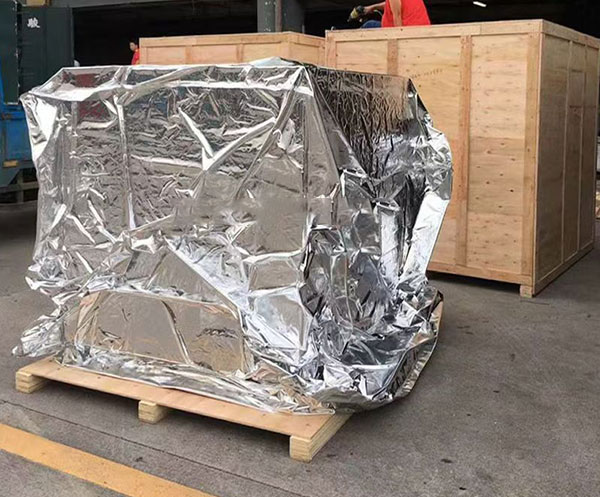
The design of the functional layer reflects the advanced nature of the protective technology. The aluminum plating layer is formed through a precisely controlled vacuum evaporation process, with the thickness strictly controlled within the range of 600-800 angstroms. This thickness has been verified through extensive experimentation, ensuring both barrier performance and material flexibility. The surface of the aluminum coating has also undergone nano-level hardening treatment, increasing its wear resistance by approximately 40%.
The protection system is meticulously designed. It employs multi-layer anti-corrosion technology, including a triple protection system of vapor phase corrosion inhibitors, contact-type corrosion inhibitors, and environmental conditioning agents. The vapor phase corrosion inhibitor creates a protective atmosphere within the packaging space, the contact-type corrosion inhibitor forms a protective film on the metal surface, and the environmental conditioning agent continuously absorbs trace amounts of moisture that penetrate the packaging. This multi-layered protection mechanism ensures that machinery and equipment remain in perfect condition during long-term storage.
The cushioning system is specifically designed according to the characteristics of the machinery. Foam materials with varying density gradients are used, with different density cushioning layers applied to different parts. High-density, slow-rebound materials are used for critical components such as precision guide rails and spindles; medium-density materials are used for general structural components. This differentiated design ensures both effective protection and optimized material costs.
III. Performance Characteristics and Protection Effectiveness Analysis
The anti-rust and anti-corrosion performance has been rigorously verified. In salt spray tests simulating marine climates, metal samples inside the packaging showed no signs of corrosion after 800 hours. Wet heat test data shows that in an environment of 55℃ and 95% relative humidity, the humidity inside the packaging remained consistently below 50%, far below the critical humidity for metal corrosion.
Mechanical protection performance is excellent. Vibration tests simulated long-distance transportation conditions, placing the packaged machinery on a 5-200Hz swept-frequency vibration table for 96 hours. Precision testing after the test showed that the changes in the key geometric accuracy of the equipment were all within acceptable limits. Impact tests showed that the packaging system effectively attenuated impact acceleration to below 12g.
Environmental adaptability meets high standards. Temperature cycling tests verified the packaging's performance stability in a temperature range of -40℃ to 75℃. Ultraviolet aging tests showed that after 2000 hours of UV irradiation, the main performance indicators of the material maintained a retention rate of over 85%. This data proves that the packaging can adapt to various harsh storage and transportation environments.
The sealing performance is reliable and durable. Using helium mass spectrometry leak detection, the packaging's leakage rate does not exceed 5×10⁻⁷ Pa·m³/s. Long-term tracking data shows that the sealing performance remains stable within 12 months, ensuring that the internal environment of the packaging is not affected by external factors. This level of sealing performance provides an ideal protective environment for precision equipment.
IV. Production Process and Quality Assurance System
Strict standards are established for raw material inspection. Each batch of base material undergoes 16 performance tests, including key indicators such as tensile strength, tear strength, and weather resistance. Functional materials require complete test reports and laboratory verification. Anti-corrosion materials must pass volatility, corrosion, and environmental adaptability tests.
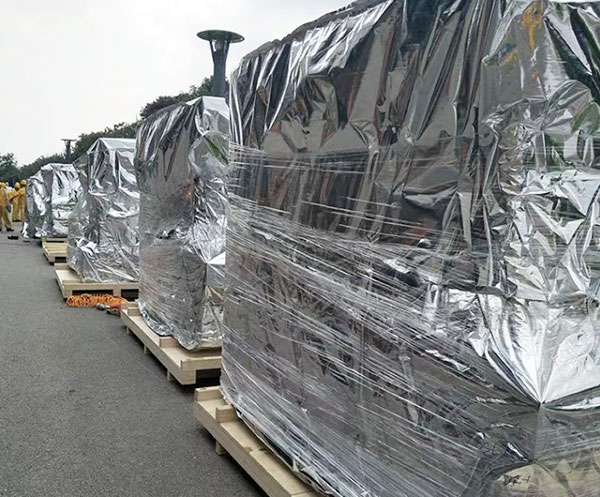
The production process is digitally controlled. The cutting process uses a CNC cutting system, which automatically generates cutting plans based on the machine's 3D data. The sewing process uses industrial-grade specialized equipment, with real-time monitoring of thread tension to ensure that the sewing strength meets design requirements. The seam treatment uses a multi-layer sealing process to ensure the integrity of the protective effect.
The anti-corrosion treatment is particularly important. An intelligent spraying system is used, and the amount of anti-corrosion agent sprayed is precisely controlled at 20-25 g/m². After spraying, segmented drying is performed, with the temperature gradually decreasing from 65℃ to 40℃ to ensure uniform curing of the anti-corrosion agent. The entire process is carried out in a clean environment to prevent contaminants from affecting the protective effect.
Quality inspection runs throughout the entire production process. The online monitoring system performs real-time monitoring of each link and automatically records process parameters. Finished products undergo full inspection, including appearance inspection, dimensional measurement, and performance testing. Type tests are conducted regularly to verify the long-term reliability of the product. All test data is entered into the quality management system for full traceability.
V. Application Practice and Performance Verification
Machine tool equipment packaging is a typical application case. A machine tool manufacturing company used aluminum-plated woven packaging bags to export machining centers. After 60 days of sea transportation and multiple transshipments, the equipment inspection showed no corrosion on the guide rail surface, and all accuracy test indicators were within the tolerance range. The vibration-damping design of the packaging effectively protected the precision ball screws and spindle system.
Injection molding machine packaging demonstrates professional advantages. A batch of large injection molding machines used a customized packaging solution, with special protection for key parts such as tie rods and molds. Inspection after transportation showed that the mating surfaces of the equipment remained intact, and there were no leaks in the hydraulic system. The successful application of the packaging shortened the equipment installation and commissioning time by 35%.
Compressor packaging verifies the protective effect. A batch of industrial compressors were stored using this packaging method for an extended period. After 18 months, inspections showed that the internal metal surfaces of the equipment remained in their original factory condition, and the electrical insulation performance met standard requirements. The long-lasting protective capabilities of the packaging saved users significant maintenance costs and prevented equipment malfunctions caused by prolonged storage.
machine-coated aluminized woven packaging bags offer high-strength, pressure-resistant, and superior moisture-proof performance, forming an excellent packaging solution for industrial equipment transportation. Designed specifically for machinery, precision components, and hardware storage and shipping, these bags effectively resist environmental hazards during transit, providing comprehensive protection for equipment safety.
The core advantages of this packaging solution lie in its high strength and precise moisture control. The multi-layer composite structure features an outer layer of high-toughness polypropylene woven fabric, reinforced through specialized processes to significantly enhance tensile and compression strength. It can withstand stacking pressure, collision impact, and handling stress, preventing deformation or damage that could affect the machinery. The intermediate aluminized layer, combined with an inner PE Film, forms a dual moisture barrier. The aluminized layer efficiently blocks moisture, oxygen, and ultraviolet light, while the tight heat-sealing process ensures stable internal conditions, keeping humidity within a safe range and preventing machinery from corrosion, rust, or performance degradation.
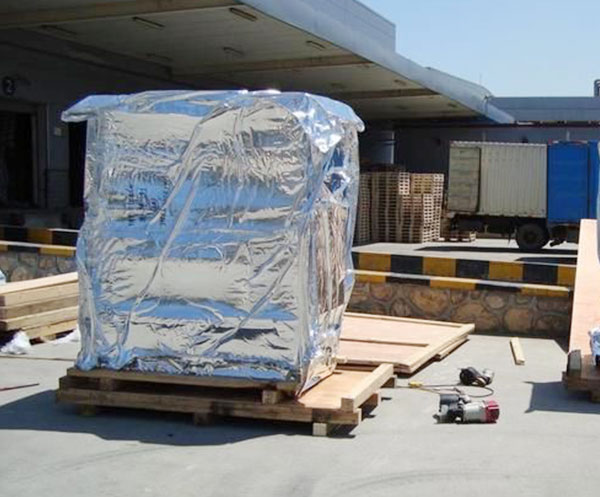
Additionally, this packaging solution is highly adaptable and can be custom-sized to fit various machine dimensions and irregular component shapes. It also provides anti-static and dust-proof properties to protect sensitive components, while its lightweight design helps reduce additional shipping costs. Compliant with industrial packaging standards, machine-coated aluminized woven packaging bags deliver consistent protection for in-plant transport, cross-regional logistics, and long-term storage, making them the ideal choice for applications requiring high-strength, pressure-resistant, and moisture-proof packaging.
This website uses cookies to ensure you get the best experience on our website.
 Español
 Pусский
 Deutsch
 العربية



 WhatsApp
 Phone
Phone