


In today's increasingly frequent global trade, sea freight, as the primary mode of cargo transportation, places special and stringent demands on product packaging. Sea freight aluminum-coated Woven Bags, as a packaging solution specifically designed for the marine transportation environment, provide reliable protection for various types of goods across the oceans through their unique material structure and protective properties.
I. Special Challenges and Packaging Requirements of the Marine Environment
The marine transportation environment poses challenges to packaging materials far exceeding those of ordinary environments. The high-salinity seawater environment is highly corrosive; statistical data shows that the corrosion rate of metal materials in the marine environment is 3-5 times higher than in inland environments. Continuous high humidity is another serious challenge; relative humidity during sea transport remains above 85% for extended periods, especially when passing through areas with significant temperature differences, leading to "container rain" inside the containers. This places extremely high demands on the moisture-proof performance of the packaging.
The long transportation cycle is also a factor that cannot be ignored. A typical east-west shipping route usually takes 30-60 days, during which the packaging needs to continuously withstand the challenges of environmental factors. In addition, goods undergo multiple loading and unloading operations, including port hoisting and ship securing, and the impacts and vibrations during these processes pose a severe test to the mechanical strength of the packaging. The temperature fluctuations are also significant; from temperate ports to tropical waters, the diurnal temperature difference can reach over 30°C, and this thermal expansion and contraction effect affects the stability of the packaging.
Ultraviolet radiation is also a factor that requires重点 protection during sea transport. When transported on deck or stacked in ports, packaging materials are directly exposed to sunlight, and strong ultraviolet rays accelerate material aging, affecting the service life and protective performance of the packaging. These complex environmental factors collectively constitute the challenges that marine packaging must address.
II. Material Structure and Protection Mechanism
Sea freight Aluminum-coated woven bags adopt a multi-layer composite structure design, with each layer providing specialized protection against the specific challenges of the marine environment. The base layer uses marine-grade polypropylene woven fabric, which has undergone special anti-ultraviolet treatment, increasing its UV resistance by more than 50% compared to ordinary materials. The warp and weft density of the woven fabric is precisely calculated to ensure flexibility and fatigue resistance while maintaining the necessary strength.
The design of the functional layer is particularly meticulous. The thickness of the aluminum coating is strictly controlled between 500 and 700 angstroms. This thickness range has been verified through extensive experiments, providing both ideal barrier properties and cost-effectiveness. The surface of the aluminum coating has also undergone special anti-oxidation treatment to effectively resist corrosion in salt spray environments. Test data shows that the treated aluminum coating performs excellently in salt spray tests, remaining intact after 200 hours of continuous spraying.
The sealing system design takes into account the special requirements of sea transportation. A double-seal structure is used, with the inner layer as the main sealing layer, employing high-temperature heat sealing technology to ensure basic sealing strength; the outer layer is an auxiliary sealing layer, using anti-aging sealing strips to provide additional protection. This design ensures that the packaging's sealing performance is effectively maintained even in extreme environments.
III. Protective Performance and Technical Parameters
Moisture resistance is a core indicator for sea-transport aluminum-coated woven bags. Through professional instrument testing, the water vapor transmission rate can be controlled to below 0.8 g/m²·24h. This indicator means that the inside of the packaging can remain dry for a long time in a standard sea transportation environment. Actual use cases show that chemical raw materials packaged in this way maintain their moisture content at the factory level after 45 days of sea transportation.
Mechanical strength has been rigorously tested. Tensile strength reaches over 60 MPa, and burst strength is no less than 1000 kPa. In vibration tests simulating a sea transportation environment, the packaging bag remained structurally intact after 72 hours of continuous vibration. Stacking tests show that fully loaded packaging bags can be safely stacked more than 8 layers high, fully meeting the requirements of container transportation.
Corrosion resistance has been verified through multiple tests. Salt spray tests show that the material did not show significant corrosion after 500 hours of continuous spraying with a 5% sodium chloride solution. Anti-mold tests show that the material showed no mold growth on its surface after 28 days in a high-temperature, high-humidity environment. These properties ensure the long-term stability of the packaging in marine environments.
IV. Production Process and Quality Control
The base material treatment process employs special techniques. Anti-aging agents and UV absorbers are added to the woven fabric during the production process. These additives are evenly distributed within the material, providing long-lasting protection. The treated substrate undergoes corona treatment to achieve a surface tension of 44 dyn/cm or higher, ensuring strong adhesion with the functional layer.
The aluminum plating process is carried out in a clean room with constant temperature and humidity. The vacuum degree is strictly controlled at above 10-2 Pa, and the aluminum wire evaporation temperature is stable within the range of 1450±10℃. An online monitoring system continuously monitors the thickness and uniformity of the aluminum plating layer; any deviation triggers an automatic alarm and adjustment mechanism. Samples are taken from each batch for testing to ensure consistent quality.
The lamination process employs multi-roll precision coating technology. The coating amount is monitored in real time by a laser thickness gauge, with an error controlled within ±1.5%. The laminated material requires 48 hours of curing to ensure full bonding of each layer. The curing environment has strict temperature and humidity standards, with the temperature controlled at 23±2℃ and the relative humidity maintained at 50%±5%.
Finished product testing includes multiple specialized tests. In addition to conventional physical performance tests, comprehensive tests simulating the marine shipping environment are also conducted. These include temperature cycling tests, vibration tests, and salt spray tests. Each product shipped comes with a detailed test report, ensuring compliance with all requirements for marine packaging.
V. Application Practices and Case Studies
The export of chemical products is a typical application area for marine-grade aluminum-plated woven bags. A large chemical company used this packaging to export plastic raw materials. After 60 days of sea transport, the product quality remained stable. Notably, even when passing through equatorial waters where the external temperature reached 45℃, the internal temperature of the packaging remained within a safe range, effectively preventing the raw materials from caking.
Applications in the food and feed industry have also been successful. A feed production company used marine-grade aluminum-plated woven bags to export aquatic feed. In the high-temperature and high-humidity marine environment, the mold rate of the feed decreased from 5% to below 0.3%. The moisture-proof performance of the packaging ensured the freshness of the feed, helping the company successfully expand into overseas markets.
The case of building materials transportation is also representative. After using this packaging, a cement production company fundamentally solved the problem of product caking during sea transport. The strength design of the packaging ensured that it remained intact after multiple loading and unloading operations, significantly reducing cargo damage. Actual data shows that using specialized marine packaging reduced customer complaints by 80%.
This professional solution is even more crucial for the marine packaging of precision instruments. One instrument manufacturing company used customized aluminum-coated woven bags to package precision equipment, and after multiple shipments, the equipment remained in perfect condition with a 100% success rate. The packaging also featured convenient lifting points, significantly improving loading and unloading efficiency.
VI. Usage Specifications and Operating Guidelines
Preparation before packaging requires meticulous attention. First, confirm that the packaging environment meets the requirements; it is recommended to perform packaging operations in an environment with a relative humidity below 60% and a temperature between 15-30℃. Before packaging, check the product condition to ensure the surface is dry and clean, avoiding introducing moisture into the packaging.
The filling process must follow professional procedures. The filling volume should be controlled at 90%-95% of the bag capacity, leaving sufficient space for heat sealing. For products prone to static electricity, it is recommended to use anti-static filling equipment. During the filling process, pay attention to keeping the sealing area clean to ensure subsequent sealing quality.
The sealing operation must be strictly standardized. The heat sealing temperature should be adjusted according to the material thickness and ambient temperature, usually controlled between 165-185℃. The heat sealing pressure should be maintained at 0.4-0.6MPa, and the time set to 1.5-2 seconds. After sealing, a seal integrity check must be performed to ensure the seal is intact and undamaged.
Special attention is required during warehousing and container loading. When stacking in the container, ensure that the weight is evenly distributed to avoid localized overloading. It is recommended to use anti-slip mats to prevent the packaging bags from sliding during transportation. At the same time, ensure that the container's ventilation system is working properly to prevent condensation inside.
Sea Freight Aluminum-Coated Woven Bags: Core Choice for High-Strength, Pressure-Resistant, and Moisture-Proof Sea Transport Packaging
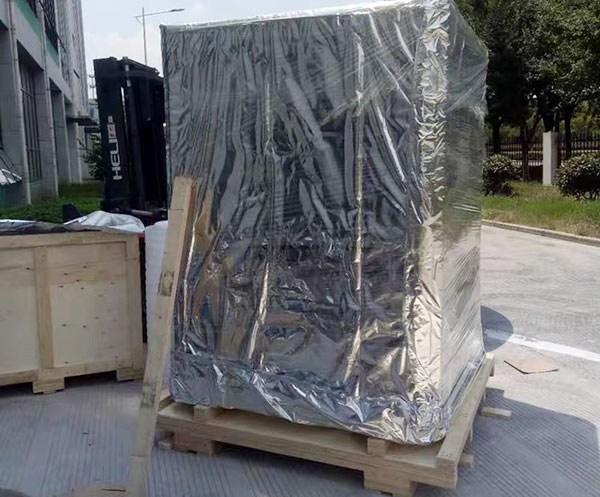
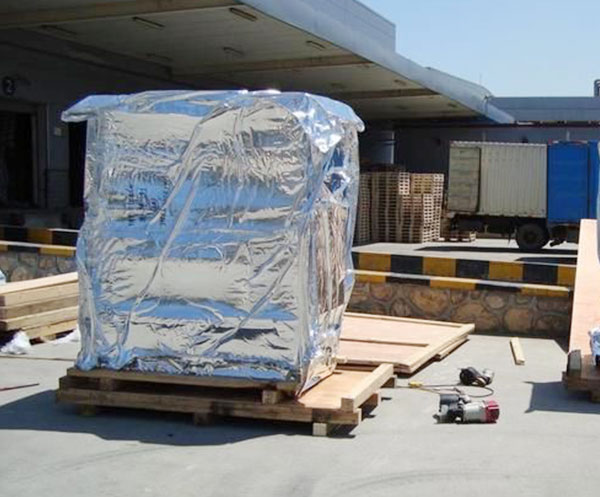
Sea freight Aluminum-coated woven bags are specialized protective packaging designed for long-distance maritime transport. With core advantages of high-strength compression resistance and effective moisture protection, they are ideal for safeguarding industrial equipment, precision components, hardware parts, and other goods against stacking pressure, salt spray, high humidity, and impact during loading and unloading.
The high-strength performance comes from premium polypropylene woven fabric, reinforced through warp and weft processing, significantly improving tensile strength and load-bearing capacity. This ensures the bags can withstand multi-layer stacking and handling impacts, preventing deformation or damage. For moisture protection, a composite structure of aluminum-coated film and inner PE layer is used. The aluminum layer effectively blocks moisture, oxygen, and UV light. Combined with precise heat sealing, it forms a fully enclosed protective barrier, preventing penetration of salt spray and humidity, and protecting cargo from dampness, oxidation, or corrosion.
These bags can be custom-sized to fit various cargo dimensions and shapes. They also feature anti-static and dust-proof properties, comply with international sea freight packaging standards, and are lightweight to reduce shipping costs. Overall, they offer a balanced solution that maximizes protection, compliance, and cost-efficiency for maritime transport.
This website uses cookies to ensure you get the best experience on our website.
 Español
 Pусский
 Deutsch
 العربية



 WhatsApp
 Phone
Phone